
 “See,” she says, sighing, “it’s like being in a fairytale!” I look around at the row of half-timbered facades, the miniature windmills propped up by metal stands, the glum looking bust of Hans Christian Anderson.
“This is not my idea of a fairytale,” I tell her. From the expression on the Danish writer’s face I’m guessing it’s not his, either.
“You don’t think it’s charming?” she asks, taking me by the arm and leading me down Mission Drive in Solvang, California.
“What’s charming about it?”
 “It’s so different, so adorable. There’s no Starbucks or McDonalds or Walmart in town, just boutiques and restaurants. I wish I lived here.” We stroll down the empty road. The European hanging signs of this self-proclaimed Danish capital of America advertise sushi, bagels, tacos, and the pizza chain Domino’s. The incongruities escape her. She drags me into a pastry shop. “Ooh! Look at those…and these…and this! Doesn’t it make you want to go crazy?” I watch in mild consternation as she orders two cream cheese croissants, a slice of almond butter ring, a half-dozen Napoleon hats, and a cinnamon roll. We sit at a diner table in a tawny flushed room filled with shabby framed posters.
“Who’s eating all these sweets?” I ask her, eyeing the sticky collection. She looks at me in surprise.
“We are! Dig in…try the custard, it’s my favorite. I take a bite, close my eyes, and imagine I’m sitting at a café on a cobblestone lane.” I obligingly break off a morsel and try to envision the same while I chew. The cloying filling stifles my inspiration; all I hear is the dreary teenage conversations of the cashiers. She senses my ennui and says, “let’s go check out some history.” Leaving the eatery we head south two blocks on foot to the Elverhøj Museum.
 “Solvang’s architecture was remodeled to attract tourists not to preserve culture,” I announce inside our destination, pointing out to her archival photos of the inhabitants’ mission style houses.
“Not this cottage,” she counters, “it says here he hand-built the homestead because he wanted to live in an eighteenth-century Jutland farmhouse.” The former residence of artists Viggo Brandt-Erichsen and Martha Mott now hosts a hodgepodge exhibition which includes Viking artifacts, modern American painters, and community memorabilia. We examine newspaper clippings chronicling the hamlet’s history. Little tokens of their heritage stand out from these images: girls folk dancing in costume, a stork positioned on a pretend thatched roof for luck, a feast after a roof-raising…. Otherwise, the accounts could be those of any California territory: arrival of immigrants, eventual acculturation, war, industrialization.
“What sets this suburb apart from the various ethnic enclaves elsewhere? Besides,” I add, “It also says only ten percent of Solvang’s population now claims Danish ancestry.”
“It has a unique appearance. Other neighborhoods don’t look like their customary homes. I mean Chinatowns don’t have Chinese accommodations. Italian quarters don’t imitate Rome or Tuscany,” she answers. “Here I think they’ve managed to transplant a little bit of Denmark.”
“So the replicated buildings make it genuine?”
“They give me the feeling, which is what I want.”
“Having a certain exterior doesn’t classify as cultural though,” I reply. “If they put a miniature Eiffel Tower here it wouldn’t be another Paris.”
 “If you want culture, you should come back for their Danish Days festival,” she says, “they put on a huge show with a torchlight parade, an æbleskiver breakfast, Viking reenactments, a dinner folk dance.”
“That’s exactly my point — they put on a spectacle for outsiders. When you explore Japantown in San Francisco for example, you experience their layered existence, the tensions between survival in a modern metropolis and the desire to retain their traditions. They’re not displaying themselves for someone else’s benefit.”
“How else am I going to learn about another culture? This is educational for me. I’ll never make it to Denmark, so this is the closest I can get to being there.”
“You’re claiming you’ve learned about a country you’ve never been to by coming to Solvang?”
“Yes, I have…and look they have genuine Scandinavian things…like this,” she argues, holding up an imported Swedish tablecloth inside the gift store for me to inspect. She buys it as a memento. “You really should see these streets on one of their annual events,” she claims as we circle Petersen Village Square later on, “That’s when everything becomes magical. I drive down each year for the event.”
“Isn’t it the same every time?”
“Yeah, that’s what I love about it. I know what I’m getting.”
“Why don’t you travel to Copenhagen this year instead? You can experience midsummer celebrations, taste frikadeller, see a Nordic battleship,” I suggest.
“Oh no, what a nightmare! Can you imagine me trying to stumble around out there? I wouldn’t understand a word they said, I’d get completely lost, and probably end up with food poisoning. No, I like that I can encounter a little Danish flavor not far from home.”
“But this is a theater production, it isn’t how the Danes live,” I insist. “Cities are more than a few famous dishes, a pageant, or a postcard landmark. They don’t have a single theme, or ethnicity, or veneer that defines them. They are complicated, evolving personas — not static.”
She shakes her head vigorously. “I don’t care for any of that…who wants to see the grimy, muddle with skyscrapers and factories and ugly stuff? It’s the romance I come for, the good bits….Speaking of which you’ve got to get your hands on one of these æbleskivers,” she states, pulling me into a café. “They’re supposed to be as good as from the old country.” We take our puffed pancakes to the Little Mermaid statue sitting atop a leaky fountain. Red jelly oozes from the top of my popover and runs down my sleeve. “Isn’t it delicious? Doesn’t it take you back to your European jaunts?” she inquires.
“No it doesn’t,” I retort sopping up the mess with a wad of paper napkins.
 Turning to the green-tinged bronze, she shoves her cake into her mouth in one enthusiastic gesture. “She’s so lovely,” she sighs, “I wonder if the other one is as beautiful as her?”
“Why don’t we find out?” I ask. “Let’s go to Copenhagen together!” Fear widens her pupils. Nevertheless, I press on. “Don’t you want to taste what æbleskivers are like over there?”
“What if I don’t like those ones?” she mutters.
“At least you’ll know. We’ll eat cream-filled desserts, we’ll sit in actual cafés by the canal, we’ll get lost together which won’t be as scary. It’ll be an adventure!” She contemplates my invitation.
“You’ll take me to visit the other mermaid?”
“Yes.”
“We’ll eat every type of danish sweet?”
“Yes.”
“I’m making a list,” she warns.
“Fine.”
“You’ll really travel to Denmark with me?”
“Why not? Then we can compare notes on æbleskivers.” I give her my uneaten one to enjoy. She munches on it, nodding as we return towards her car.
“Okay, let’s do it,” she replies, adding, “Gosh, I really hope they’ve got windmills as cute as these….”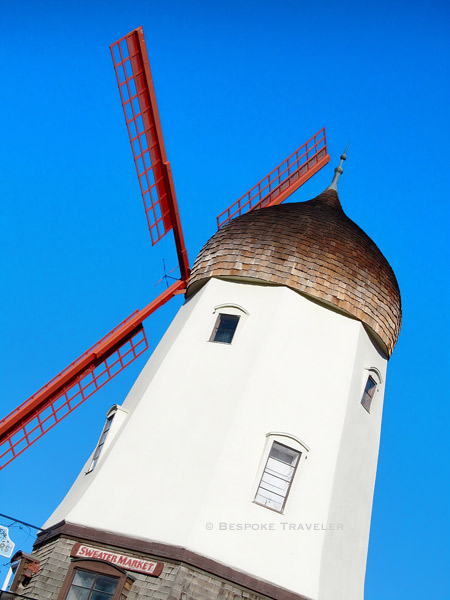
TRAVEL NOTE:
Since the debut of the award-winning American movie “Sideways,” which was filmed in the surrounding Santa Ynez valley, Solvang has courted a new type of tourist, the wine-lover. Tasting rooms and bars of Solvang cater to the area’s grape varietals.
Have you been to a themed town like Solvang? Let me know about it in the comments below.
Discover more from Bespoke Traveler
Subscribe to get the latest posts sent to your email.






 Bespoke Traveler
What a charming town and great post … a place I’d love to visit.
Let me know what you think of it when you do.
A themed town not really but I’ve been to Epcot 😀 does that count.
I think that counts as having visited many themed towns all at once. 🙂
Hehe, this is great, I can imagine just this sort of conversation for real. And they then come to the real thing and nothing is as they assumed and expected. And yes, they all speak this pesky other language. 😀
It’s probably bizarre, but I am more excited about what her reaction will be when we explore Denmark than my going there! 😉
So it’s a go! Well done! 🙂
I haven’t been to anywhere quite like Solvang. The closest thing I can think of was Huis Ten Bosch theme park near Nagasaki, Japan which was built to look like a Dutch town. Having been in the Netherlands a number of times, I was surprised how authentic the park looked.
Intriguing. I wonder why so many places like to replicate Scandinavian or Bavarian architecture in their themed towns and parks?
I’m just guessing now but probably because it has worked so well for Disney and other themed towns? It’s the money, honey! $$$$$ Cha-cing!
It’s a good point. I’m not sure.
I am very happy (and surprised) at the ending of your story! That’s great that you both will go to the real Denmark. The only thing I like about these reproductions, is the photos. They look nice and pleasing and I do enjoy strolling through towns like this for that reason. But, of course, the real thing is 100% better and more exciting. I enjoyed reading your story, since it reminds me of how a lot of people on this country think… 🙂
I was excited she agreed to come with me! Strangely Solvang had me thinking a lot about zoos and aquariums again…the same thing happens there. I manage to get pretty photos of animals and settings, but the experience is far from satisfactory.
I hope you get to Denmark. Fake travel is so unsatisfying…..
I am looking forward to exploring Denmark at some point. Fake anything turns out to be most unsatisfying to me. Thanks for stopping by!
Kind of Disney, but not? Can’t say it appeals. 🙂 Let us know how the trip to Copenhagen goes. Now there’s a place I’d love to go. And it’s just a little way across the sea…
I am excited to experience Copenhagen, but maybe more excited to see how my friend reacts to it. 😉 I predict future awkward conversations to be recorded.
I’ve never been to Solvang, but your photos/account remind me of Holland (Dutch) and Frankenmuth (German), Michigan. I always think of these places as reminders of the early immigrants who populated these areas so long ago. Maybe they’re kitsch and there aren’t many people of those origins left (actually the area around Holland is full of Dutch descendants), but I hope they remain as quirky monuments to those who once dwelled in the area. Otherwise, that part of the history of those regions would probably be forgotten. A roadside plaque or statue commemorating the former settlers just wouldn’t have the same impact. 😉
I think if Solvang had begun that way — Dutch immigrants building houses that reminded them of their old home — it would have seemed more appropriate to me. Elverhoj, which is now a museum, seemed more in tune with this sort of commemoration than the rest of the town.
And I thought I’d see a model of a town made of matches. 😉
The only themed “town” that occurs to me is an open air museum in Stockholm called Skansen.
😀 Intriguing. I did not know there were themed towns in Scandinavia as well. Have yet to visit Stockholm, but when I do I would like to drop by Skansen to see what it is like.
Solvang is indeed a beautiful quaint Danish village. Soon enough you will see Andersens’s Little Mermaid set on a stone by the water in Copenhagen!
I hope so. I wonder whether I will have a different view of that one afterwards….
Wow! this is a lovely informative post! I stay quite close to Solvang and had no idea that there is such an interesting place to visit. Thanks for describing it in a lighthearted and funny manner. 🙂
😀 Solvang isn’t for everyone, but many people find its themed nature adorable.
I have missed you. Thank you for another thoughtful post. How intriguing to imagine this one written from your friend’s point of view. We would be left with a completely different impression. I hope you will get her to visit Denmark with you.
That is very sweet of you to say. As for the other side of the coin, that would indeed be a very interesting perspective. I am also hoping she will accompany me to Denmark at some point.
When I was very young I visited Solvang. I remember it was really wonderful. 😀
Perhaps younger people get more out of it than adults do…it was not for me, but I am looking forward to discovering what the real Denmark is like someday.
Love the dialog, but think I’d feel the same way as the story teller about the pretend village
Thank you. Pretend villages are not for me, but they seem to satisfy a lot of other people. Aside from visiting Disney as a youngster, this was my first themed town experience.
Interesting. I haven’t ever been to Solvang, but have always wondered. Your description sounds as though it’s a bit like Disney World’s Epcot Center, which I found quite absurd. I also don’t understand the fascination with the Little Mermaid. I skipped over it on my first visit to Copenhagen as I didn’t realize that it was a “must see.”
I’m not sure what the fascination with the Little Mermaid statue is either. Many towns vie to have one, apparently. Solvang did feel like Disney if you went on a day when no one else was there.