
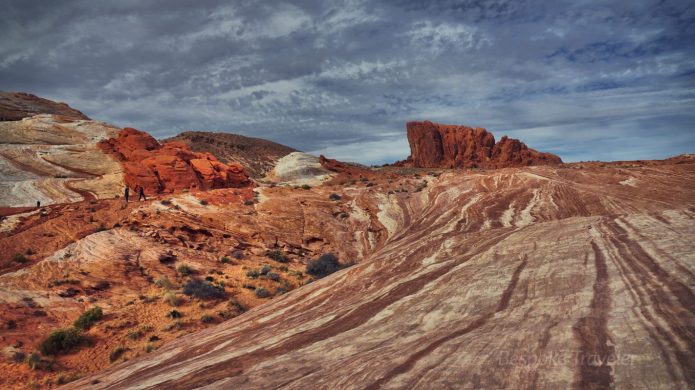
 Long, long ago in a time far, far away, I used to be a geology student. I learned about the tectonic forces of our planet, of the way its seething inner core spewed out unguent minerals, of the possibilities inherent in ongoing cycles of erosion and deposition. I practiced identifying crystal structures and the atomic composition of polymerized silicates. While outdoors I would annoy friends and family by shouting, “igneous dike!” “graphite schist!” or “look at that exposed cross-bedding beauty!”
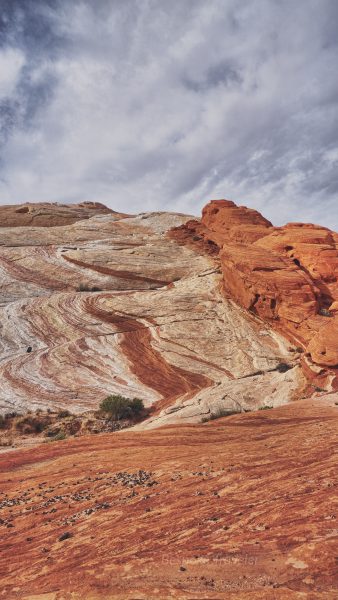 At Valley of Fire I return to those half-forgotten lessons. They don’t seem as distant when I gaze upon the one-hundred-fifty million year old solidified sand dunes undulating through the basin. These are no mere rocks to be glumly passed by while hunting for richer treasures. They have come alive, laying out past aeons for me to read. This is where an inland sea once transformed into a sandy desert before petrifying into multi-colored rock. Foundations shifted, became exposed by plate movement. Now they undergo abrasion.
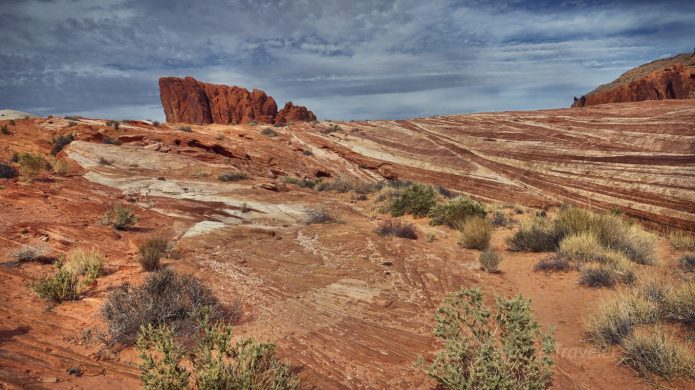 Here are the stratifications evident from centuries of weathering. Here are overturned cretaceous layers indicating the leading edge of a thrust sheet. Further along my hike are faults composed of deformation bands and sheared joints. I perceive time wrinkled in the processes — epochs squished into stratum the width of a quarter, the entire era of dinosaurs a comma in the swirl of lithological storytelling. I feel my life span slipping away, dissolving into the gradations of petrography. Instead of sensing that a handful of seconds had occurred between the counting of hours, I see centuries float by in the blink of an eye.
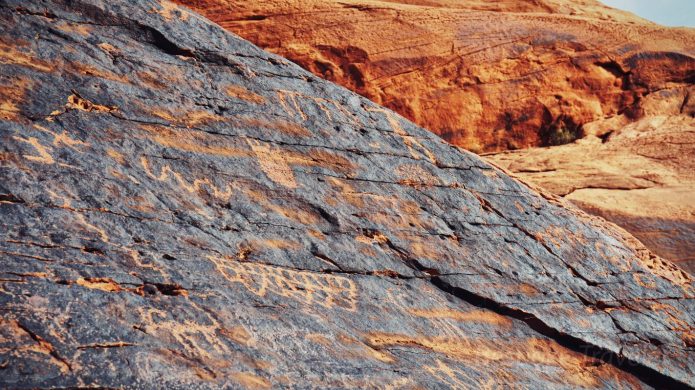 Human history is evident at Valley of Fire too: in the Ancestral Pueblo petroglyphs, the remnants of film sets, the scrawled declaration that “Bob Was Here.” Our species is intent upon leaving a trace…somehow…anyhow. We can’t bear the thought of vanishing into the future, or a cosmos unaware of our presence, or a timeline in which we never mattered. What ‘progress’? We’re eternally in a whirlwind to be remembered…somehow…anyhow…repeatedly searching to connect, to be relevant…now and ad infinitum.
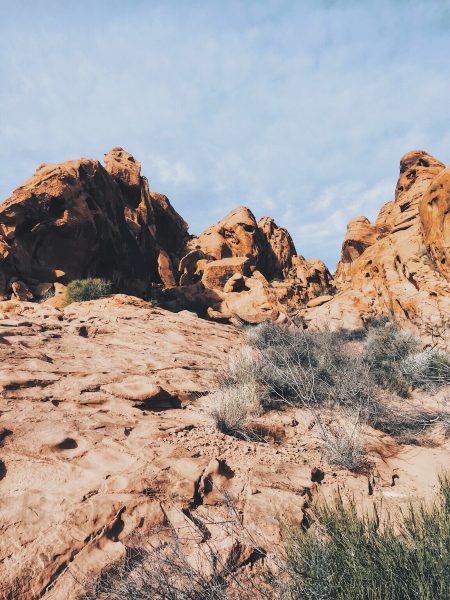 This apparently ageless terrain is clever at hiding its metamorphoses. But, if I listen carefully, the earth’s skeleton tells me tales of our mutual inexorable looped journey. In the shimmering heat a vision appears: the rippling hills and valleys quiver at the edge of fluidity, recalling the primordial sea from which they were born while pronouncing a destiny in which they’ll return to their aquatic past. Time halts and flashes forward in sweeping luminescent waves. Amidst shifting light the variegated topography croons of time that was, of time that is, of time yet to come.
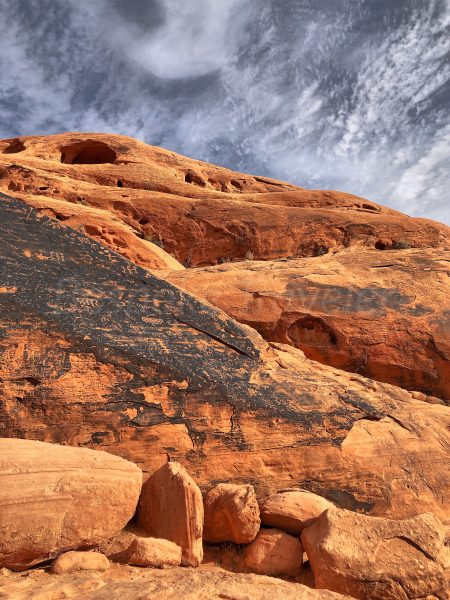 Those long ago geology lessons echo against the fiery bedrock, reminding me of movement on a different scale to mine — of changes imperceptible yet vast. I step out of time’s bonds to gain a foothold upon the immense formation of experience.
TRAVEL NOTE:
While Valley of Fire is a feast for the eyes, it can also be an olfactory adventure. One of the oldest plants on our planet, creosote bushes carpet the desert during springtime, giving off a musky scent after rainfall. When visiting, please remember that off-trail travel causes damage to the ecosystem.
What’s the most surprising aspect of a desert environment to you? Let me know in the comments below. Also if you’ve visited any petroglyph sites I’d love to find out what the experience was like for you.
Discover more from Bespoke Traveler
Subscribe to get the latest posts sent to your email.





 Bespoke Traveler
Marvelous captures of color country.
Thank you!
Those rocks look as chocolate that has melted and then coagulated back together. Amazing.
Mmm…hadn’t even thought of this comparison, but now you’re making me want chocolate ice cream….🧐
Great photos and a beautifully written piece
Thank you for letting me know, I’m so glad you enjoyed it!
Wow! A superb article and a geologist nirvana! 😀 Here you could practice your knowledge to your heart’s content … and we would all be impressed with your naming of the rock formations. Incredible images and thoughts of our history saved in such a small scope. You write with poetic musings about this amazing visit as you:
‘. ..perceive time wrinkled in the processes — epochs squished into stratum the width of a quarter, the entire era of dinosaurs a comma in the swirl of lithological storytelling.’
As for people making their mark upon the landscape, this seems to be an indelible part of human nature … the rock carvings on the west coat of Sweden always hold me in quiet awe.
A beautiful and thought-provoking post…thank you for sharing here! 😀
I appreciate your thoughtful praise! Exploring Valley of Fire was indeed a sweet treat for the rock-lover in me. 😊 I don’t often get to see the earth’s history laid out so beautifully. I had no idea there were rock carvings in Sweden! Hopefully, when I return to visit at some point, I’ll be able to visit these on the west coast.
One of the main rock carvings site is close to where we stay when visiting Sweden and it is now a World Heritage Site. In my early days of blogging I wrote about it here: https://annikaperry.com/2015/04/29/the-4000-year-old-story/ I hope you get to visit someday … the atmosphere is amazing when walking around, viewing the images!
Excellent. Will be popping over to check out the story and taking notes for my petroglyph site list. Thank you for the extra information!
I love the poetic descriptions: they are even better than the beautiful pictures. 👍💖
The aspiring poet in me thanks you for that. 🥰
You are doing a great job! 👍
I love how you’ve written this, Atreyee, braiding together your love of and past history with geology, and your current experience and photographs. The photos are magnificent. Thanks for sharing this. 🙂
I’m grateful for your kind words, Cathy. It’s nice to be able to still put my geologic knowledge to some use during my travels. 😁
Isn’t it nice when you have knowledge about something that you can bring to bear on your travels? I find that very satisfying. 🙂
It’s a beautiful landscape that makes us contemplate time and our lack of it. Why people deface things I don’t know, but in time their etchings will fade away.
I don’t understand the desire to destroy the natural environment either. Thankfully, none of the graffiti is on plant leaves or tree trunks.
While I was certainly not a geology student or expert, I do still fondly recall those classes. My favorite term was monadnock, for whatever silly reason, but I am more likely to run into other features when I’m actually out in the world, and some of the old geology comes back. Like you, I enjoy rocks’ display of time passing, and your examples here are so clear, and beautiful to boot!
A beautiful Native American term for lone mountain, monadnock! I also like this term for eroded sedimentary shields better than inselberg. My favorite memory of geology classes was watching a small chunk of limestone fizzing when dilute acid solution was dropped on it.
Amazing history, interesting facts. A real eye opener!
Thanks for letting me know how much you enjoyed the post. ☺️
Your photos are as fabulous and your words as evocative as the landscape. I have always admired geologists, but have never had the intellectual capacity to grasp the times and forces involved in the genesis of earth’s rocks.
Thank you for that marvelous compliment. Memorizing the progression of geologic eras was my least favorite part of the subject! As I’ve gotten older, I’ve arrived at a more complicated view of time, so wrapping my head around the numbers has gotten easier.
Stunning. And thought-provoking. Thank you for sharing!
I’m delighted that the post spoke to you!
It’s always a real treat to read your posts 🙂
What a beautifully written post. I’m so glad of your history with geology because it allowed me to see the Valley of Fire in a whole new way. I love the last sentence.
Alison
Thank you so very much Alison. I’m very grateful that my (limited) geology knowledge allows me to view landscapes with a different perspective, one I love to share!
What surprised me the most the first time I visited a desert is how cold it can get during the night and how much species had adapted to these barren conditions.
Yes, the fact that so many animals and plants thrive in such arid conditions continues to amaze me too! Thanks so much for this.
In the Sahara desert I learned how fantastic life is – so many animals and so much life in a place I thought rather “dead”! Beautiful shots and post – thank you!
I’m so pleased the post spoke to you. For a long time I thought of deserts as no more than long lines of sand dunes, so it’s been thrilling to really explore their variety and the vibrant life that thrives in these environments.
I have visited petroglyph sites, one of them in southern Alberta at a park called “Writing on Stone”.
Your tribute to the beauty of stone and change and desert is really wonderful – lyrical. 🙂
Thank you so very much for your praise. This is the first time I’ve been able to study petroglyphs and I’m looking forward to putting together a list of other sites to visit in the future, so “Writing on Stone” will be duly noted!
I like the putting-in-perspective of such an environment. Humans need it urgently.
You are right, as usual! Each of us needs the daily reminder that a healthy planet means a healthy us and we need help figuring out how to make that happen on small and large scales.