
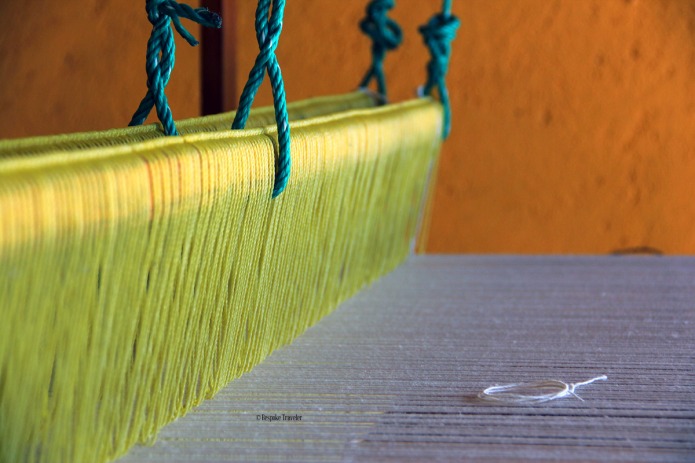
 There were no signs here, no restaurants, no shops, and no Spanish spoken. A lone dog, its head on its paws, eyed me in boredom. “Down there is where the pumas live,” Daniel, my chaperone said, pointing to the dense rolling hills surrounding us. We advanced towards a barn house. Cacti carpeted the yard. An elder hunched over a loom outside the front door. Splays of butterfly yellow spooled out from his apparatus.
“You’ve found me,” a man in a navy embroidered shirt announced in English as he came out. He spoke to the weaver in a melodious and lilting tongue.
“Zapotec,” Daniel whispered. “It’s the only way to communicate with anyone in the village.” When they’d finished their conversation, Daniel introduced me. “Meet Nico, his family has been farming and weaving here for centuries.”
“Yes. Welcome to our workshop!” Nico replied, smiling. “Come inside. I will show you where the magic happens.” In the living space tapestries of indigo, mauve, and sepia riddled with geometric cyphers hung from the wall, draped over the dining table, and covered the floor.

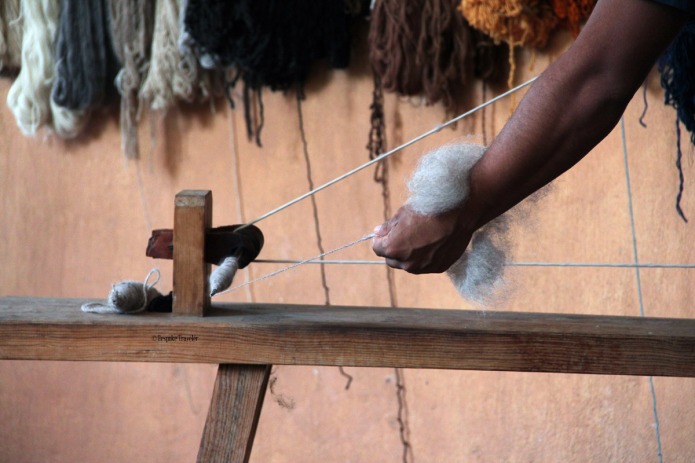
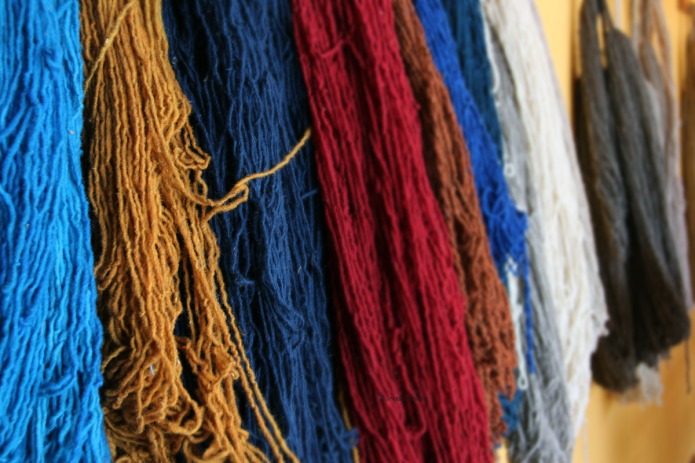
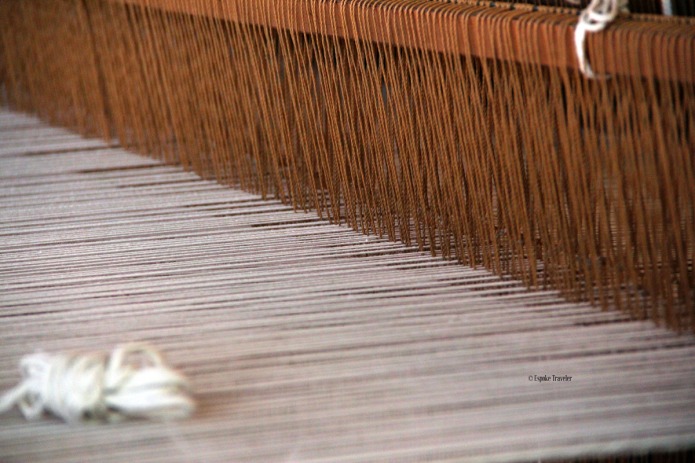
For the next hour and a half Nico instructed us on local ingredients his parents use to dye the wool; “everything we grow here or get from our neighbors.” He showed us mixing and mordanting processes; “it all depends on timing.” He taught us traditional designs that convey meaning for his tribe; “the zig-zag represents lightning, the spiral is our life cycle.” Finally, he demonstrated how to operate the treadle loom. His fingers flew over the shuttles, darting between the curtain of yarn and the frame. His feet pedaled smoothly, so that both the heddles and the levers made a rhythmic beat as the carpet set into its pattern.
“When did you start learning to weave?” I enquired.
“At six years old.”
“Nico just decided to return to rug making, though,” Daniel explained. “He’s been overseas studying.”
“Oh! What were you studying?”
“I completed my master’s degree in textile engineering.”
“Before that, he graduated as a chemistry major. His parents hoped he’d join a tech start-up or go into academia.”
Nico laughed. “Yes, instead I’m disappointing them by carrying on the old traditions.”
“What made you want to return home?” I asked.
“This is where I belong. I could have pursued those other careers, but they felt too small for me. I thought if I was going to give my life towards any profession, it should be one that called to me, something that was a part of who I was.”
“You don’t feel trapped? Worried about the prospects of your dying craft?” Daniel teased.
“That is always a concern. But I am hoping that by putting my education towards guiding my ancestor’s knowledge into the future, I can both keep their skill alive and infuse innovation into it.”
“You should see all the clever ideas he’s got to expand the business.”
“I’m not ready,” Nico replied, embarrassed, “there’s so much to be done and I’m still in the process of figuring out how best we should move forward.”
“Nico’s thinking of going beyond the conventional motifs, really bringing the design component into the future.”
“And what do your parents think about that?”
“They’re unsure of course. I’m trying to make them understand that implementing computer graphics and creating more complex sketches will get our artistry noticed. But, right now I’m excited about color play. I’m like a kid in the lab….” Nico scurried between his baskets of marigolds, tarragon, persimmon, moss, and cochineal animatedly handling the seeds, powders, and leaves. “I’m changing the water type I use…experimenting with oxidation levels…combining different acids and bases…researching different fibers as well.”
“Are you modernizing to aniline dyes?” Daniel asked.
Nico grinned. “No, no, no…I would never do that…it would be easier and faster, but where’s the fun?”
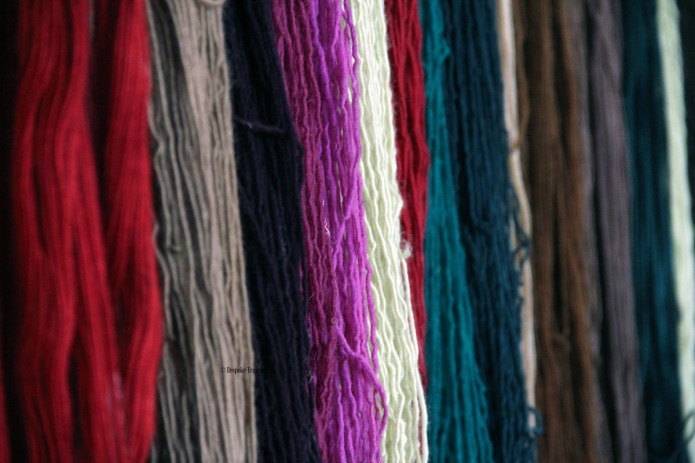
Like any creative endeavor weaving is an arduous craft. Very few of the villagers still practicing the art make a name for themselves. Since Nico employs only natural methods, each process is even more time consuming. Despite his uncertain future, it was refreshing to see Nico so enthusiastic, willing to forego the dependability of other occupations to commit to weaving. Perhaps it’s because I so often struggle to feel confident in my metier, but I admired Nico for his audacity and dedication.
“You’re seeing this through, then?”
“My dream is to have one of my designs displayed in an avant-garde museum, so that there’s a thread between the artistry of my forefathers and what lies ahead.”
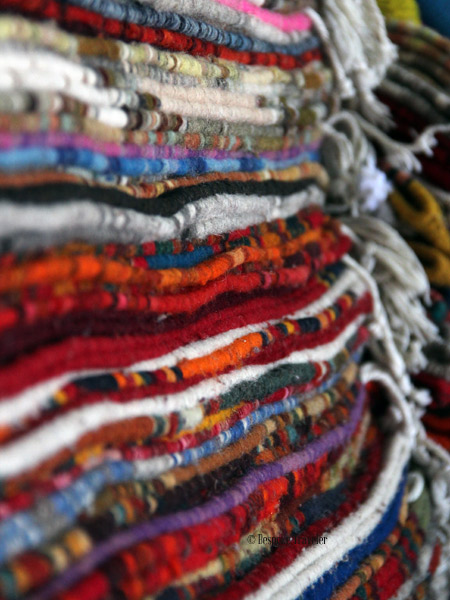
As we veered to the kitchen for lunch, I couldn’t stop ruminating about Nico’s vision. It’s difficult for the past to coexist with transformation. It either gets obliterated or mummified in arrested development. So, I’m eager to discover how Nico will honor the path of his ancestors while embracing our digital age. I hope he will be able to usher history forward as he seeks to weave the future into the past.
TRAVEL NOTE:
Most artisans live and work deep in Oaxaca valley and use middlemen to sell their wares in the markets. They continue to depend exclusively on tourism and face economic and social barriers. While visiting make sure to travel outside of Oaxaca City, into the region’s ethnic villages each of which specializes in a different craft such as pottery, textiles, wood carvings, and silversmithing.
Watching (and interacting with) local artisans is such a wonderful entry into discovering a culture. Let me know about crafts people you’ve encountered whose work has amazed you and feel free to add a link to their shops, or your own if you are a maker, in the comments below!
Discover more from Bespoke Traveler
Subscribe to get the latest posts sent to your email.





 Bespoke Traveler
Thank you for the beautiful post. Nico’s story was wonderfully told. I loved his sense of belonging and that he came back to his heart’s calling after all those years of studying!
I suppose no career path is easy, but I think he’s so brave for returning to his village and trying to hold fast to the wonderful things there. Thanks so much for dropping in and for your thoughtful comment. ☺️
I really hope Nico will be able to carry on his mission for many years to come. For me the more I travel the more I appreciate my local culture, and the more I realize how far I’ve distanced myself from it without knowing. So it’s always exciting to see people like Nico who choose to embrace their own centuries-old culture and make sure that they will still be relevant in the future.
I have had a similar experience! Traveling has awakened me to the fact that there’s so much I will never know about my own culture or familial traditions. Given the hold technology jobs have on the world, it is heartening to meet people like Nico who are happy to embrace their roots and still find their traditional crafts pertinent. Thanks, as always, for your insight.
The workshops in the villages around Oaxaca city are amazing! I still have a bunch of calavera sculptures and alebrijes that I bought during my time there.
They really are. I haven’t even gotten to some of the other villages that specialize in pottery or wood carvings! So glad you got a chance to check some of them out when you visited.
You express the dilemma so beautifully–how to weave tradition with contemporary expression. I admire Nico’s confidence too in the future. Like you, I struggle with confidence. But ultimately we all have to follow our passion–regardless of what others think and regardless of our own faltering confidence! 🙂
People like Nico inspire me to be bolder about the choices I make. Thank you for your lovely comment.
I’m glad he’s following his calling, and it looks like he will be able to merge in everything he’s learnt during his degree too!
Me too. Thanks for stopping by to chat!
Wow! A wonderful post and the spirit of Nico shines through! His devotion and enjoyment is incredible and I had to raise a wry smile how his parents were disappointed he wanted to continue and work with this beautiful tradition. I feel his passion will carry his designs and work further into the future. Many thanks for sharing. Ps the photos are brilliant, so vibrant and colourful!
Thank you! You picked up on the irony there. Many of the elders in Nico’s village don’t see a future for their craft or even for small-scale farming. They encourage their children to move to the city and pursue more modern jobs.
Tes photos sont de toute beauté et c’est merveilleux de voir un métier à tisser avec toutes ces belles couleurs.
Belle journée.
Merci beaucoup. C’était un plaisir d’apprendre l’art du tissage et de la teinture de la laine d’un maître artisan. En vous souhaitant le meilleur.
Thank you for sharing a look into this beautiful art form. Nico seems a lovely person as well.
Always enjoy being able to view more of this world through your lens! 🙂
How kind of you to say Takami! I appreciate your visits and am delighted that my stories give you pleasure. ☺️
I love this article about Nico & what he’s doing to honor his forefathers in the history of weaving, more power to him who instead of distancing himself from the past generation’s way of life is embracing it instead. The photographs are colorful & lovely!
I was decades ago a fiber artist, and experimented with all forms of the medium from weaving to felting to basketmaking. Thanks for the memories.
Happy to hear it brought back good recollections for you. I’ve never had any experience with weaving so it was fascinating to learn about the entire process. What made you switch from being a fiber artist to photography?
It really wasn’t a switch; I had been photographing for years before working with fibers.
Wonderful profile of this young man eager to unite a traditional art form (also a form of story telling) with new horizons. I bought a six-foot long piece of weaving in Mexico that was made in Oaxaca. It occupies the place of honour over the mantle of my fireplace.
How lovely to hear that you have a piece of ancient Oaxaca art over your mantle! I had never thought of weaving as either an art-form or as story-telling, until I spent time with some of the crafts people.
Interesting story and pictures. Great writing!
Thank you so much for those kind words. I look forward to stopping by to reflect upon your lovely photos.
Brilliant … no other words
Thank you for that. ☺️
“My dream is to have one of my designs displayed in an avant-garde museum, so that there’s a thread between the artistry of my forefathers and what lies ahead.” That’s wonderful! I hope Nico’s dream will come true. (And maybe it will, thanks to you!?
I am delighted to help Nico in various ways as he figures out how best to feature his family’s work. I too am looking forward to a bright future for his art.
A wonderful post – I hope Nico is able to bridge his ancestry with modernity. A difficult task.
Thank you Lynette! I agree. Hopefully, he will know how to keep the right balance in his artistry.