
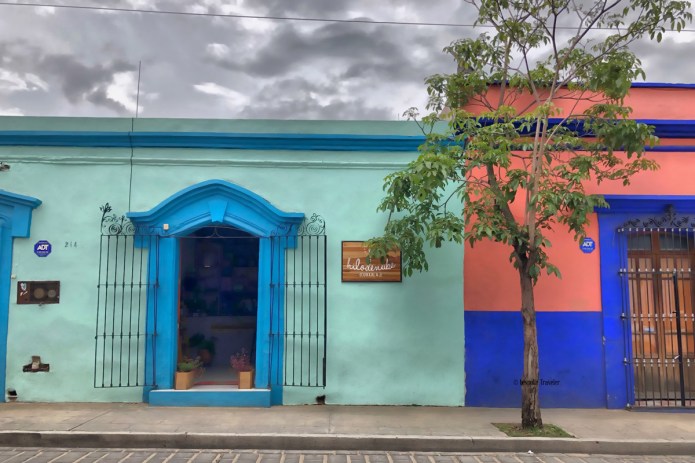
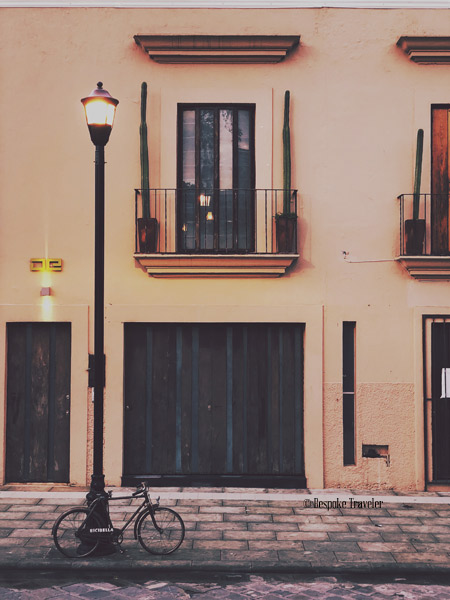
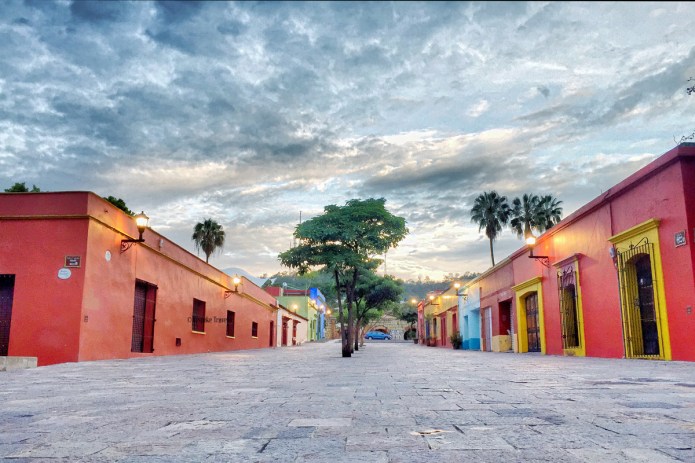
Ultramarine, coral, cadmium, lime…the house colors captivate me. They are an essential effervescent palette of Oaxaca, Mexico. To me they are also a significant message. They lead my eye to other juxtapositions: the clusters of maroon and purple bougainvillea trailing everywhere partner well with the ubiquitous jade of the cactus fences. Native succulents are used in all sorts of clever ways here — for sustenance, for enclosures, for remedies. In fact the sixteen indigenous tribes of this region see value in every portion of their environment. Interdependence is their credo.
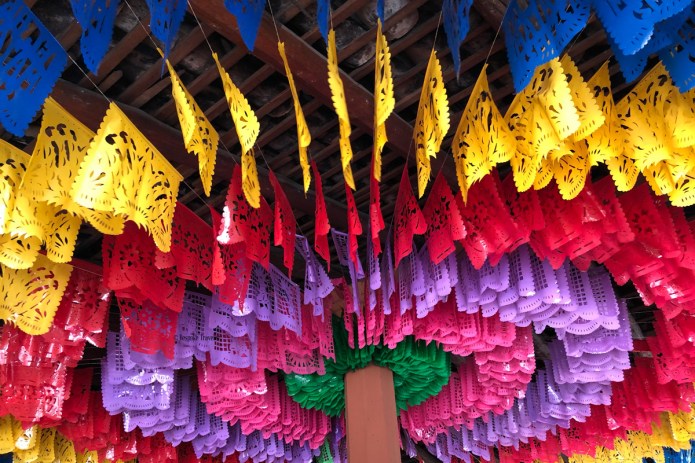
I learn about this, slowly. First, there is the proper collection of grasshoppers and agave worms for meals. Then, the lessons on how beans, squash, and corn flourish when grown with each other. I become familiar with the peculiar scent of copal. Next, the importance of symbols: zig-zag ladders for lightning, geometric spirals for life cycle, stylized figures for maguey.
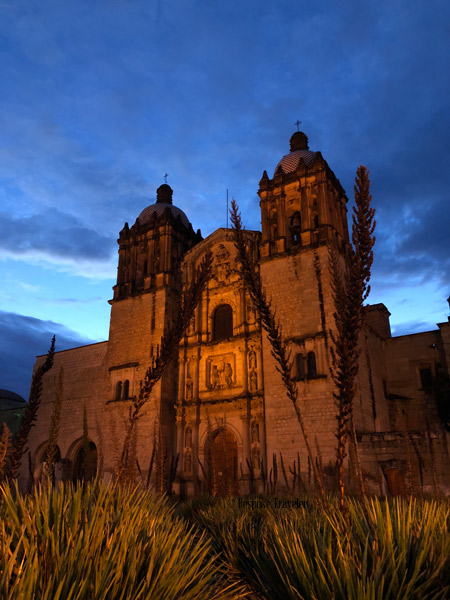
Finally, follow the Pre-Aztec myths about pumas, wild rivers, and bat-gods. To me the stories are fascinating. For Oaxacans their legends are an integral means of transferring generations of knowledge about their traditions, how to live in accordance with nature, what to cherish. It is also a way to keep the music of their language alive. Language and land, I discover, are crucial to Oaxaca. They bear witness to one another. Together, they maintain the area’s unique diversity, both cultural and biological.
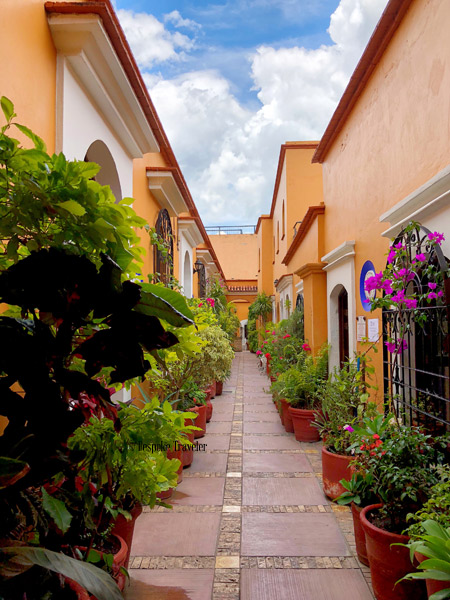
Of course the same problems plaguing every society — greed, jealousy, abuse of power — fester in Oaxaca too. The narrow valleys are considered impoverished by consumerist standards. The stewardship of the variant ecosystems by local communities is judged inadequate since there is no political or corporate oversight. The native reliance on territorial subsistence and well-being is viewed as anathema to modernization, progress, and globalization.
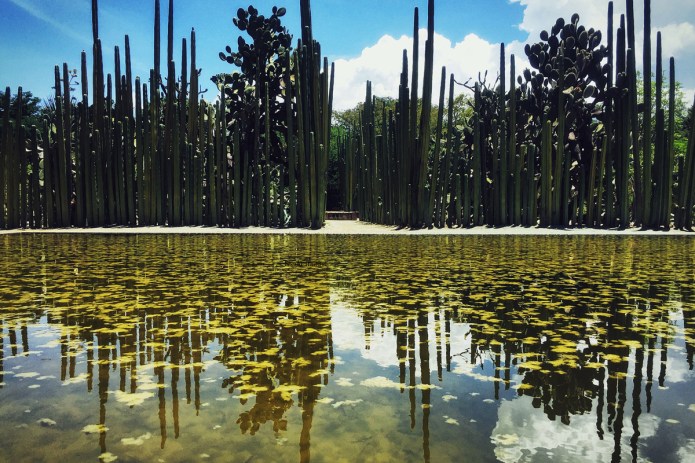
Despite the cultural instruction, my prejudices feed into these narratives as well. I pass by tin shacks and assume misery; I see plates of chapulines and presume scarcity; I encounter pantheistic artwork and infer orthodoxy. It’s not until I visit the ethnobotanical gardens that I realize how inextricably cultural heterogeneity is linked to ecological diversity. The connections are nuanced, but undeniable. The garden forces me to examine the multifaceted links between wild plants and humans. It reveals the successful development of ancient civilizations through their interaction with flora in aesthetic portrayals.
Oaxacans are adamant that if these relationships are not valued, if they are not protected, loss of belief and loss of identity will occur. Solutions to prevent a heritage deficit and the demise of harmony, however, cannot come from the outer world. They must be ministered by the community; specifically appropriate to Oaxaca; in balance with the terrain and those belonging to it; fused with both artistry and wisdom.
It’s been a privilege to observe Oaxacans taking responsibility for their particular plots, tending and preserving case-by-case, forging ever stronger bonds with the part of themselves which hearkens to the call of the earth.
TRAVEL NOTE:
Among the thousand other endemic botanical specimens, the cacti of Oaxaca are as meaningful to the indigenous as corn. It is best to treat the living plants with respect, to avoid painful situations.
Colorful houses are a mainstay of warmer climates. Let me know a memorable destination where you’ve seen some creatively colored facades in the comments below!
Discover more from Bespoke Traveler
Subscribe to get the latest posts sent to your email.






 Bespoke Traveler
Gorgeous colours. I remember seeing vibrant coloured houses and shops in Little India, Singapore. The bright colours bring a smile to my face. 🙂
Yes, I couldn’t get enough of them. 🙂 They make for wonderful photos, but I’ve learned that in Oaxaca they are so much more than just a pretty scene.
👍🏼😊
You’ve done a great job capturing the complexities of Oaxaca! It’s such a beautiful and unique place. It’s such an interesting mix of history and politics, like no other place I’ve ever experienced.
Thank you so much! I so agree with you – Oaxaca is like no other place I’ve experienced, either.
Great course and information. What is maguey?
🙂 Thank you. Maguey is a type of agave plant, a Cactus native to Oaxaca out of which the locals make the alcoholic beverage mezcal.
I find myths and legends from different cultures so interesting. You can learn a lot, I think, by listening to them carefully, there is often a lot packed in.
I completely agree with you Amy! I love a good story, and cultural myths often are packed with tons of intriguing life lessons as well. I very much enjoyed the ones I heard in Oaxaca.
I’m not the best at growing things. Nor do I know how copal smells. But it looks like a place I could learn. I was thrilled to grow and eat zucchini this year, but then I discovered that it had been an exceptional year for them. Beginners luck! 🙂 🙂 I always think that Irish houses look wonderful, with their gleeful colours. And Tobermory, in Scotland. Neither one a warm clime but something to lift the spirits.
Congratulations on the zucchini! I haven’t made it to Tobermory or Ireland, so you’ve intrigued me. I think bright colored houses in a cold clime would be a great way to offset grey weather.
I like the blues and greens, and I like a culture which respects the wildlife and plants.
The blues and greens are lovely aren’t they? I couldn’t decide on a favorite set of colors myself.
Wonderful photos. I love especially those colorful photos, because I love colors and strong especially. It was me a great joy to see a bit of Mexico thru Your photos. Thank You sharing them with us.
Have a good day!
Oh, I’m so glad. You would love Oaxaca because you’re partial to strong colors! Enjoy the rest of your week.
Their culture seems similar to those of northern (Canadian) indigenous peoples.
An enjoyable read and beautiful photos. 🙂
Someone else said the same thing! I’m intrigued as I don’t know anything at all about Canadian indigenous communities. In what parts of Northern Canada do they live?
There are many indigenous communities all over the north. In the far north are Inuit and Inuvialuit, and farther south are Gwitch’in, Dene and Cree. These are just some. 🙂
Too often we see things from the perspective of those with power, usually conceived in a way so that it appeals to a larger audience but in the end it’s the former who reap the most benefits. Many traditions, often spanning hundreds of years, survive to this day for a reason: they sustain the people and the nature which together form a healthy ecosystem and community which are unique from one place to another. It’s time for us to learn more from places like Oaxaca, and in doing do we have to make the effort to switch our default perception of things.
Your comment is the perfect conclusion to my post. Thank you. “Too often we see things from the perspective of those with power.” And so often, we don’t even realize that that is the perspective we’re holding onto. I discovered in Oaxaca, that despite all these years of travel I still have a lot of switching to do.
Gorgeous images – and a lovely description and text
I’m so glad you enjoyed the post!
Wonderful.50 yeras ago I lived in Mexico in Tuloca for morethan 6 monds.Great memories for me
I have a deep love for Mexico and it makes me happy to know that you still have such fond memories of your time living there.
A great reflection on Oaxaca… wonderful perception and understanding of a place so central to ancient civilisations. There really is a lot more colour now than when I was there in the 70s … that is good to see. Pride in the community is visible … thank you for explaining the connectivity with nature, the environment. Their heritage depends on it … your words have taken me back to those evenings in the Central Park, those mornings in the market drinking the fabulous bowls of hot chocolate while listening to the wandering mariachis
I appreciate your fantastic comment! Drinking bowls of hot chocolate in the morning is also one of my favorite pastimes in Mexico.
What an amazing, insightful, and illuminating posting. I learned much of value from reading this. When I saw the word Oaxaca, I only thought silver jewelry. It’s so much more.
Thank you! Indeed, Oaxaca is so much more. It is one of the most culturally diverse and biodiverse regions in Mexico. 50% of the country’s native species reside there as do 53% of Mexico’s indigenous language speaking population!
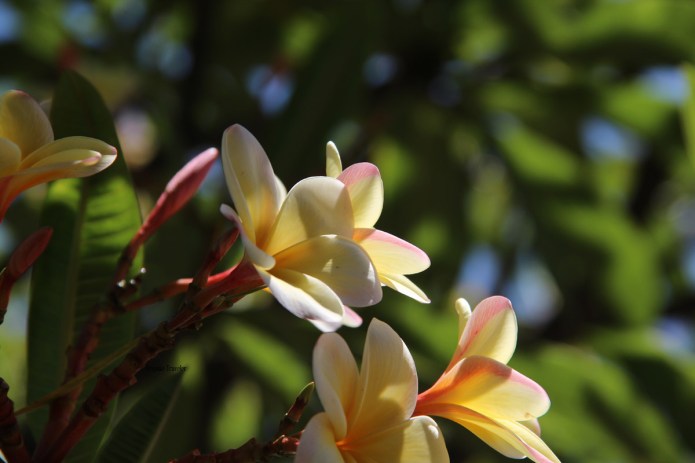
Thank you, I am so refreshed by the beautiful narrative & stunning photos of Oaxaca. “Kalachuchi” is how we named the yellowish white flowers that has sweet fragrance in Cebu.
Ah, yes, that flower is native to Mexico and Central America. But, I’ve also seen them in Hawaii too, where they are made into leis.
It is best to treat the living plants with respect, to avoid painful situations.
Especially the cactus and their equally prickly wards (beware what you’re taking pictures of when you’re attached to your camera)
Absolutely great advice to follow when in the vicinity of spiny plants!